August 21, 2026
How to Get a Puppy Used to Being Alone Without Rushing It
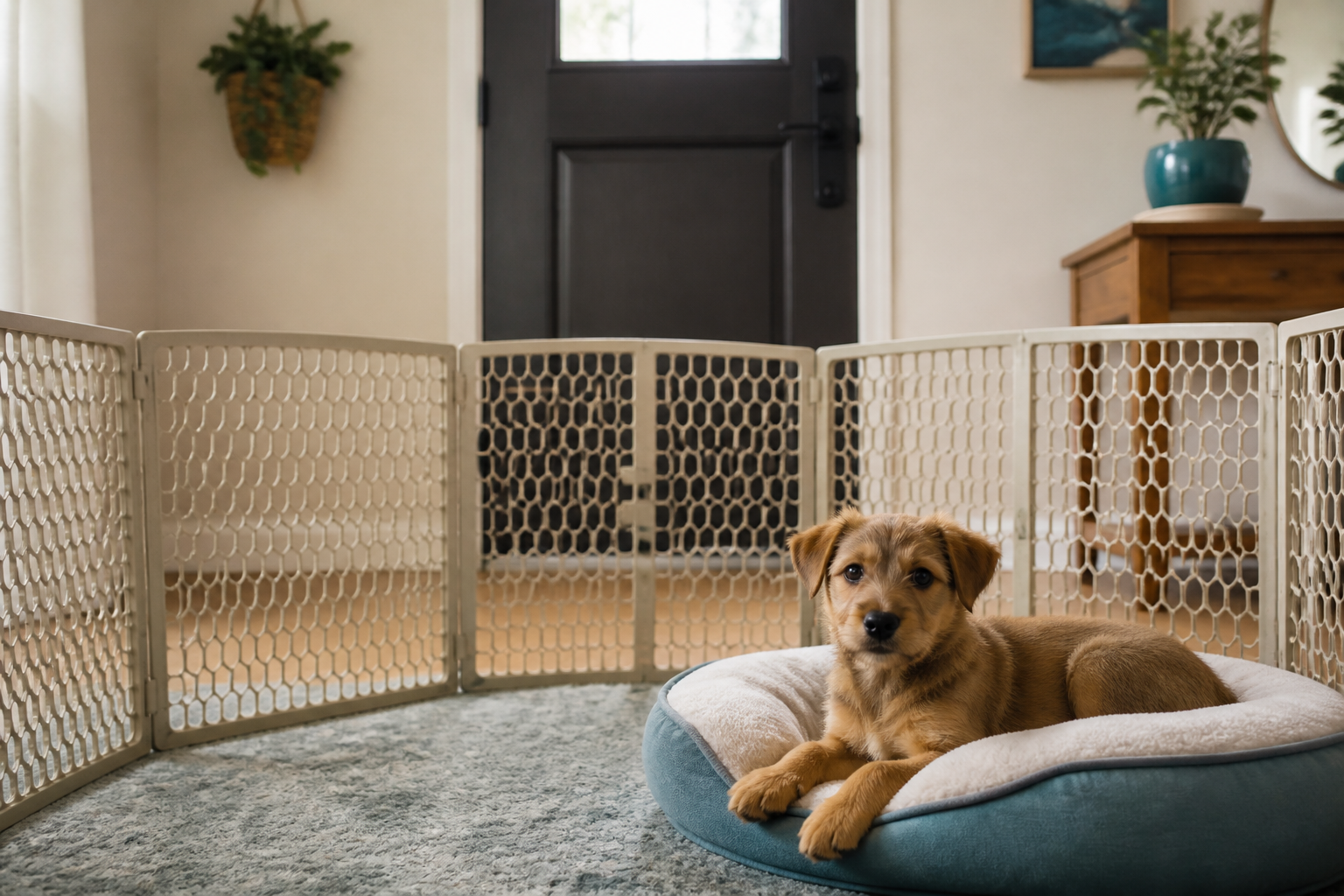
If your puppy cries the moment you step away, the answer is not to disappear for longer and hope they get used to it. Start with an absence so small that your puppy can stay calm, return before worry builds, and repeat. Alone training works best when you build comfort first and duration second.
That may mean closing a baby gate for five seconds, walking out of sight and straight back, or touching the front-door handle without leaving. The starting point is whatever your puppy can already handle without escalating.
Why being alone is genuinely difficult for a puppy
A young puppy has just lost the constant company of their mother and littermates. Then they arrive in a new home full of unfamiliar sounds, smells, people, and routines. Following you is not manipulation. It is a sensible safety strategy for a small social animal.
The goal is not to prove that crying gets ignored. It is to teach a more useful pattern: you leave, nothing frightening happens, and you come back.
Find your puppy's current starting point
Before you plan a thirty-minute absence, find the smallest separation your puppy can manage comfortably.
Try one of these while your puppy is awake and their needs have been met:
- Sit on the other side of a baby gate for a few seconds.
- Take one step out of the room and return.
- Walk to the front door, touch the handle, and sit down again.
- Open and close the door without going anywhere.
- Step outside for one or two seconds, then come back in calmly.
Use a phone or pet camera when you move out of sight. What matters is not silence alone. A puppy can be quiet while frozen and worried. Look for a loose body, normal sniffing, comfortable eating, or choosing to lie down.
A gradual puppy alone-training plan
1. Build a safe place before using it for departures
Choose a puppy-proofed pen, gated room, or other comfortable area with water, bedding, and enough room to change position. Help your puppy enjoy time there while you are still home. Feed meals there, scatter a few pieces of their normal food, and let them enter and leave when it is safe to do so.
A crate can be useful when it has been introduced positively, but it is not automatically the right tool for every puppy. If confinement creates frantic escape attempts, stop and reassess the setup.
2. Practice separation while you are still inside
Walk briefly behind a gate or around a corner, then return. Keep the first repetitions almost boringly easy. Several calm five-second repetitions teach more than one five-minute attempt that ends in panic.
Change only one variable at a time. If you add distance, keep the duration short. If you add duration, practice in a familiar part of the home.
3. Make departure cues ordinary
Puppies quickly notice shoes, keys, coats, and bags. If those cues always predict a difficult absence, worry can begin before you reach the door.
Pick up your keys and make tea. Put on your shoes and sit down. Open the door, close it, and continue with your day. These tiny rehearsals help separate the cue from a long departure.
4. Add real absences in seconds, not leaps
Once your puppy can cope with you moving out of sight indoors, step outside briefly. Return while they are still calm. Repeat at different easy durations rather than making every attempt longer than the last.
For example, a session might be five seconds, eight seconds, four seconds, then ten seconds. Easier repetitions prevent the exercise from becoming a predictable march toward something overwhelming.
5. Increase only after calm repetitions
Move forward when your puppy repeatedly stays relaxed at the current level. If they begin vocalizing, pacing, scratching, panting, refusing a normally valued food, or staring at the exit, shorten the next repetition.
That is not failure. It is information about the current limit.
Should you wait for your puppy to stop crying before returning?
You do not need to turn the doorway into a standoff. If you can return during a tiny pause, that can help keep the reunion calm. But do not remain outside while a frightened puppy escalates simply because you are waiting for perfect silence.
Repeated distress rehearses distress. If crying starts quickly, the training step was too hard. Return without drama, help your puppy settle, and make the next absence much shorter.
Where food and enrichment fit
Part of your puppy's normal meal in a safe food toy can make an easy practice feel pleasant. Use an item only after you have watched your puppy use it safely under supervision. Some puppies chew, tear, or swallow enrichment products once the food is gone, so a new item should not be left unattended by default.
A lick mat can support the beginning of an already-manageable absence. It cannot tell you whether your puppy stays calm after the food is finished, and it does not treat separation anxiety. A camera gives you that missing part of the picture.
If your puppy ignores food the moment you prepare to leave, take that seriously. Loss of interest in a normally valuable reward can be a sign that the exercise is already too difficult.
Prepare for unavoidable longer absences
Alone training cannot be rushed to fit tomorrow's workday. If your puppy currently manages only seconds or minutes, arrange help for longer unavoidable periods. That might mean a family member, trusted sitter, neighbor, or appropriately timed care.
Make sure your puppy has had a toilet opportunity and suitable activity before practice, but do not try to exhaust them into coping. A puppy who is overtired can become harder to settle, not easier.
When to ask for professional help
Speak with your veterinarian or a suitably qualified behavior professional if your puppy:
- panics almost immediately despite very small training steps;
- drools heavily, soils in distress, or tries to escape;
- injures themselves or damages doors and confinement;
- cannot eat when departure cues appear;
- is getting worse rather than gradually more comfortable.
Pain, digestive problems, urinary needs, and other health issues can also affect settling, so sudden or intense behavior deserves a veterinary check.
The simple rule to remember
Do not train the clock. Train the feeling.
Your puppy is ready for a slightly longer absence when the current one has become safe and uneventful. Build enough calm repetitions, and being alone stops feeling like an emergency.
Keep reading
- Is it separation anxiety or boredom?
- How to stop barking when you leave
- What to do when a dog finishes a lick mat and then cries
- Can you leave a lick mat with a dog home alone?
- The complete dog separation-anxiety guide
Sources used for the guidance
Common questions
How soon should I start leaving my puppy alone?
You can begin with very short, low-pressure separations once your puppy has had time to feel safe in the home. The useful question is not whether they have reached a fixed age, but whether they can remain relaxed for the tiny step you are practicing.
Should I let my puppy cry it out when left alone?
Do not deliberately leave a puppy to escalate into panic. A brief protest is different from sustained distress, but repeated crying, pacing, escape attempts, drooling, or refusing food means the step is too difficult. Make the next practice shorter and easier.
How long does it take to teach a puppy to be alone?
There is no honest universal timeline. Progress depends on the puppy, their history, their current sense of safety, and how consistently you practice below their distress threshold. Measure calm repetitions, not how quickly another puppy reached an hour.
Can I use a camera while training my puppy to be alone?
Yes. A camera helps you see what happens after the door closes. Look for loose posture, normal engagement with food or toys, and settling. Panting, pacing, repeated vocalizing, frozen posture, or fixation on the exit means you should shorten the next absence.